
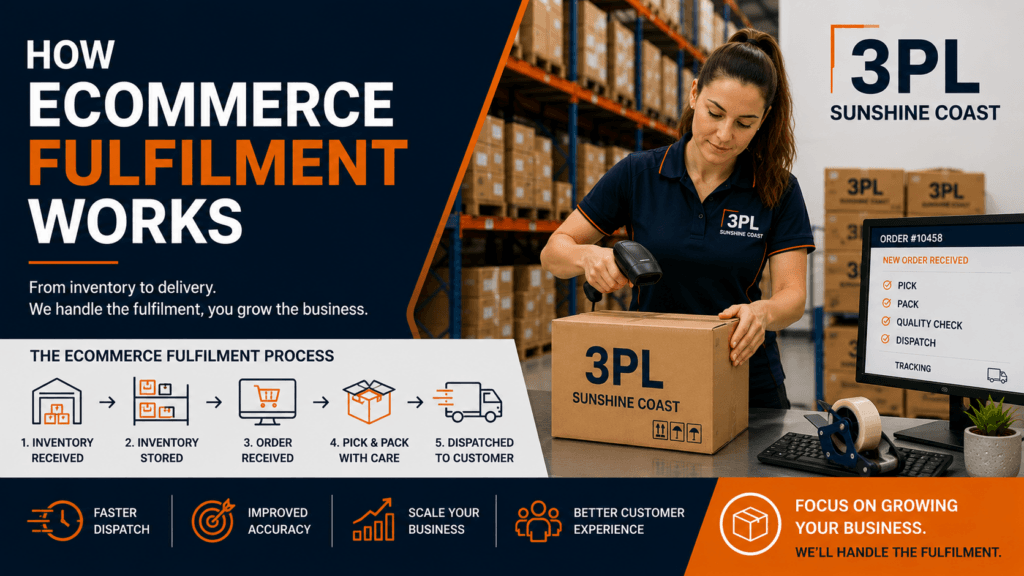
How Ecommerce Fulfilment Works
If you run an online store, ecommerce fulfilment is the process that turns customer orders into delivered products.
Ecommerce fulfilment covers receiving inventory, storing products, processing orders, picking items, packaging and dispatching orders to customers.
Modern fulfilment systems can integrate directly with ecommerce platforms, reducing manual administration and improving efficiency.
Step 1: Inventory Arrives At The Warehouse
Products are received into the warehouse and checked against incoming inventory information.
Stock may be stored as:
- Pallet locations
- Cartons
- Bins
- Shelving systems
Learn more about our warehouse storage solutions.
Step 2: Products Are Stored
Inventory is organised within warehouse locations to improve picking accuracy and stock visibility.
Warehouse systems help track:
- Stock quantities
- Inventory locations
- Movement history
- Order activity
Step 3: Orders Enter The System
Customer orders can automatically flow into fulfilment systems from ecommerce platforms including:
- Shopify
- WooCommerce
- Marketplaces
- API integrations
Our warehouse systems can help automate these workflows.
Step 4: Orders Are Picked And Packed
Warehouse staff locate inventory and prepare orders for shipment.
This process may include:
- Barcode scanning
- Picking products
- Packaging products
- Quality checks
- Shipping label generation
Learn more about our pick and pack services.
Step 5: Orders Are Dispatched
Completed orders are dispatched using suitable shipping providers and tracking information is generated where available.
Customers receive their products while business owners focus on growth rather than warehouse operations.
Benefits Of Ecommerce Fulfilment
- Less manual administration
- Reduced warehouse overheads
- Improved dispatch speed
- Scalable operations
- Improved customer experience
- Reduced handling errors